|
This
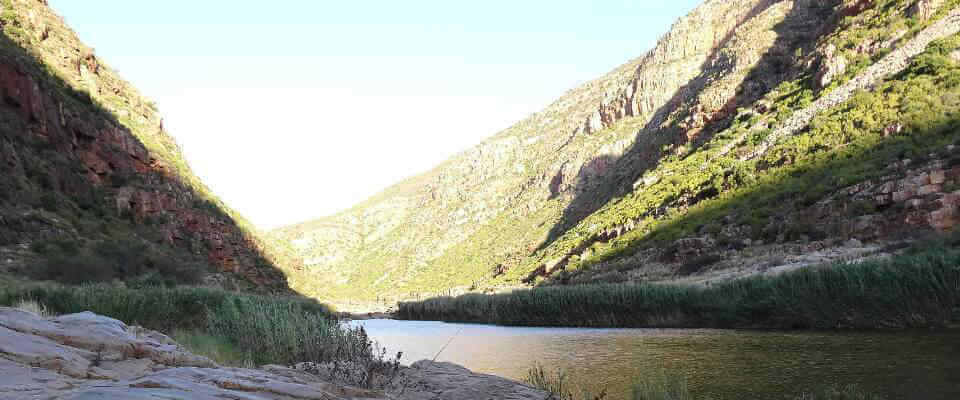
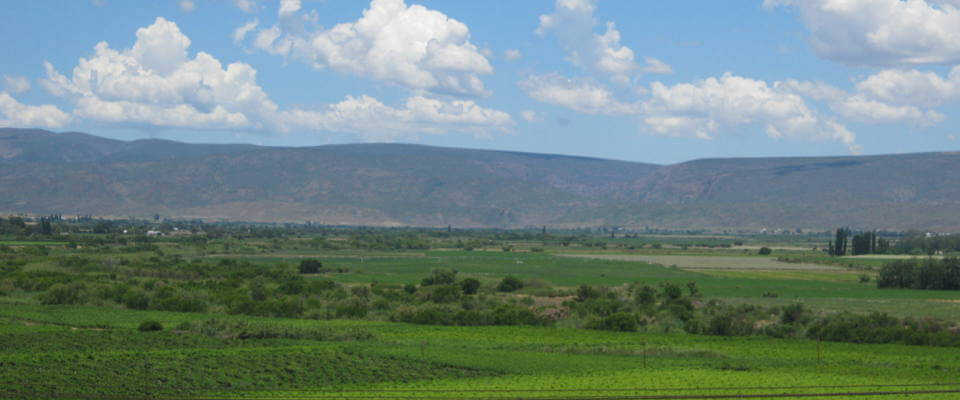
fertile valley was originally a lake. The soil is mainly alluvial and
agricultural crops are grown 1 km on either side of the rivers (Nels and
Gamka meaning lion in khoi).
Early
writings prove that the khoi called Kannaland the valley with no grass.
Evidence of early San and Khoi peoples are evident in numerous rock
paintings found In the surrounding mountains.
In
1821, land was granted to JJ and MC Calitz who named it Buffelsvlei. This name
was derived from the local vegetation and animals found here.
In
1853, the Calitzs donated land for a church and school to be built, as
Oudtshoorn proved to be too far to travel for their monthly Nagmaal.
In
1910, the population was 4000 and a larger church and school were needed. Both buildings
were completed in 1912 The church
has a neo-Byzantine style with a Marseilles roof. It is a good example of the
sandstone architecture of the ostrich-era In the little Karoo. It was declared a
national monument in 1991.
Also
in 1912 , building commenced on the old Standard Bank building , presently
housing the museum , and the Calitzdorp dam. This dam wall was the first of
many to be built in South Africa ,using cement.
Subsequent
drought , the great flu epidemic, and the collapse of the ostrich feather
industry ,played havoc amongst the community.
New
hope however, came to Calitzdorp in the form
of a Railway line (in 1924) and
Electrification
(in 1937 ), as well as the construction of the first cement road between Calitzdorp
and Oudtshoorn ( also a first for South Africa ). The new R62 was built in 1978.
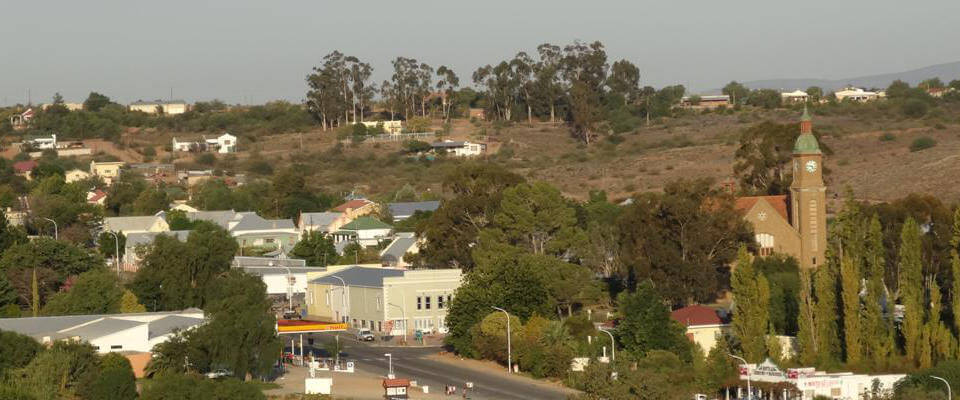
Today, this Klein Karoo thriving community is known as the Port Wine Capital of South Africa; , and the Fruit Basket of Kannaland.

Original Church
Geology of
Calitzdorp and Environs
A study of the past establishes a
set point in history from which we can perceive our present state in Time, and
perhaps look forward into the future using it as a reference.
During the early Cretaccous Period
the ancient super continent of Gondwana split up and Africa was finally separated
from South America, Australia, India and Antarctica, standing alone for the
first time. In a period characterized by warm humid conditions with lush
vegetation and the big lizards, the earth crust underwent major change as it
stretched and split. It was accompanied by violent earthquakes and torrential downpours
as rocks fractured and ruptured along the fault lines. Crustal extension was
also responsible for the formation of elongate basins such as the Oudtshoorn
Basin of the Eastern Little Karoo which extends as far west as Calitzdorp.
This basin developed mainly along a deep fracture running from East to West
along the base of the Swartberg called the "Kango Fault" (also an
important ground water conduit). The basin floor subsided mainly along it's
Northern Margin, as rocks were crushed and fractured along the Kango fault line.
Accompanying this, rejuvenated rivers on the new highlands of Gamkasberg and
Rooiberg as well as from the uplifted area to the North, flowed into the
Oudtshoorn basin. They carried with them vast amounts of scree and rock,
fractured from the Table Mountain sandstone and Quartzite's from the mountain
chains surrounding the Little Karoo, and deposited the on the emerging lake
shores.
These course continental sediments
are unique in being one of the first truly African sediments, having been laid
down during the time that the African continent was being formed. They were
previously known as Enon Conglomerates but are now called the "Buffelskloof
Formation", after a nearby farm. The rounded cobbles and pebbles were laid
down in silica rich gravels and sediments and are known as conglomerates. The
angular rock scree on the slopes covered by these same sediments are known as
Breccias.
Along the Northern shores the
sediments are rich in an iron mineral called Hematite which oxidized in the warm
humid climate to a reddish colour , giving Red Stone Hills it's name. Originally
this belt of red, gravel sediments formed the Nothern margin of the Oudtshoorn
basin but 100 million years of erosion has left isolated koppies in a band
stretching from De Rust almost to Calitzdorp. Initially eroding quite quickly, they formed
an outer crust which was somewhat more resistant. However weathering has broken
through some of this resulting in small caves and overhangs as well as a rather
spectacular Hole-in-the Wall.
Due to the highly oxidizing
conditions prevalent at the time of their formation, fossil remains are
virtually non existent although found elsewhere in other Cretaceous deposits on
the shores of the ancient Kango basin as well as in older Jurassic deposits.
This has resulted in some difficulties in establishing the exact age of these
deposits of red gravel.
Incredibly, there are two examples
of relict species that have lived on from these ancient times for an
uninterrupted span of 100 million years. A Gymnosperm in the form of the cycad
"Encephalartos horridus" is still found
in secluded valleys and an ancient fish species is still found in perennial
streams in the foothills of the Swartberg near Calitzdorp.
Courtesy of
Geoff Wyatt-Goodall
|